

Parijat (Nyctanthes arbor-tristis), known by several names like Harsingar and Night Jasmine, is a captivating plant found extensively in the Indian subcontinent. Known for its divine fragrance and unique flowers, Parijat flower holds a special place in gardens, temples, and Ayurveda. Its flowers bloom at night and drop by morning, symbolizing fleeting beauty. The Parijat tree is not only cherished for its fragrant blossoms but also for its vast array of medicinal properties.
Let’s explore everything you need to know about Parijat, from its mythological stories and health benefits to how to care for this enchanting plant.
Table of contents
Introduction to Parijat Flower
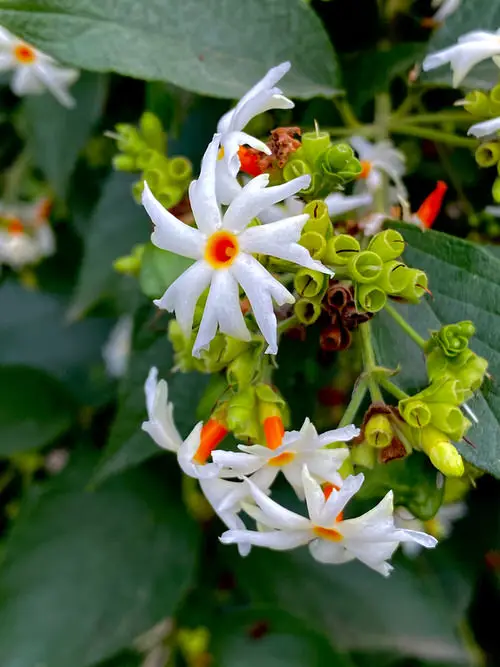
The Parijat tree is a small, deciduous tree that can grow up to 10-15 feet. Its large, green leaves are rough and textured, while the flowers are small, star-shaped, and white with a bright orange stalk in the center. The Parijat flowering season usually falls between August and December, when the flowers bloom during the night and fall by the morning. This gives the tree its popular name, Night Jasmine. But unlike most flowers that bloom during the day, the Parijat ka phool exhibits a magical night-time charm.

Parijat Tree Characteristics Table
| Details | Information |
|---|---|
| Common Name | Parijat, Harsingar, Night Jasmine |
| Scientific Name | Nyctanthes arbor-tristis |
| Family | Oleaceae |
| Origin | Indian Subcontinent |
| Habitat | Tropical and Subtropical regions |
| Plant Type | Small Deciduous Tree |
| Indoor Plant | No |
| Outdoor Plant | Yes |
| Leaves | Large, Green, Textured |
| Flowers | White petals with orange center |
| Flowering Season | August – December |
| Fruit | Capsule containing two seeds |
| Seeds | Winged seeds |
| Roots | Fibrous |
| Height | 10-15 feet |
| Growth Rate | Moderate |
| Light Requirements | Full sun to partial shade |
| Soil Requirements | Well-drained, rich in organic matter |
| Water Requirements | Regular, avoid waterlogging |
| Temperature Requirements | Warm, humid, frost-sensitive |
| Humidity Requirements | Moderate to high |
| Propagation | Seeds, Stem Cuttings |
| Uses | Ornamental, Medicinal, Religious |
| Medicinal Properties | Anti-inflammatory, Antipyretic |
| Toxicity | Non-toxic |
| Cultural Significance | Religious rituals, Hindu mythology |
| Common Pests | Aphids, Mealybugs |
| Common Diseases | Fungal infections due to overwatering |
| Special Care Tips | Avoid frost, ensure proper drainage |
| Cultural Practices | Use in religious ceremonies |
| Vastu Direction | North-East, East |
Religious and Cultural Significance of Parijat Flower
The Parijat tree story is deeply rooted in Hindu mythology. It is believed to have originated during the churning of the ocean, or Samudra Manthan, and was gifted by Lord Vishnu to Goddess Lakshmi. The tree is considered sacred and is often associated with devotion and worship. Parijat ka phool is used in religious rituals and is offered in temples, especially to Lord Vishnu and Goddess Lakshmi.
Another popular belief about Parijat is its association with love and longing. The flowers are said to represent eternal love, as they bloom at night but fade by dawn, much like the fleeting moments of love in life.
Parijat Benefits: Medicinal Properties and Health Uses
Parijat holds a special place in Ayurveda due to its numerous medicinal properties. The various parts of the plant, including the leaves, flowers, and bark, are used to treat several health conditions.
Key Health Benefits of Parijat Flower:
- Joint Pain and Arthritis: The leaves of the Parijat tree are known to be effective in reducing joint pain and arthritis. A decoction made from the leaves is used to relieve swelling and inflammation in joints.
- Fever and Malaria: The juice extracted from Parijat leaves is used to treat fevers, especially those related to malaria.
- Skin Problems: The flowers and leaves have anti-inflammatory properties that are beneficial in treating skin conditions such as itching, rashes, and eczema.
- Digestive Issues: Parijat flower is also used to improve digestion and is effective in treating constipation and indigestion.
- Cold and Cough: The bark of the Parijat tree is used in traditional medicine to relieve symptoms of cold, cough, and bronchitis.

How to Grow and Care for Parijat Tree
Parijat care is relatively easy, making it a popular choice for home gardens. It thrives well in tropical and subtropical regions and requires minimal maintenance.
Light and Temperature Requirements:
- Parijat thrives in both full sunlight and partial shade.
- It prefers warm, humid climates but can also tolerate some cold weather. However, it should be protected from frost.
Soil and Watering:
- Parijat requires well-drained soil, rich in organic matter.
- It needs regular watering but be cautious to avoid water stagnation, as this can damage the roots.
Parijat Tree Propagation:
Parijat can be propagated either by seeds or by stem cuttings.
- Seeds: The seeds are sown in nursery bags and then transplanted once the seedlings are strong enough.
- Cuttings: Stem cuttings can be directly planted in the soil. Regular watering is essential for them to root properly.
Parijat Flowering Season and Bloom Time:

Parijat flowering season is usually from late summer to early winter. It typically takes 2-3 years for the plant to bloom after being grown from a seed or cutting. Once mature, the tree blooms profusely during its season, with the flowers lasting from evening to early morning.
Parijat Tree Name in Different Languages
| Language | Name |
|---|---|
| English | Night Jasmine |
| Mandarin | 夜茉莉 (Yè mò lì) |
| Spanish | Jazmín de la noche |
| Hindi | पारिजात (Parijat) |
| Gujarati | હરશિંગાર (Harsingar) |
| Arabic | ياسمين الليل |
| Bengali | শেফালী (Shefali) |
| Portuguese | Jasmim da noite |
| Russian | Ночной жасмин |
| Japanese | 夜ジャスミン (Yoru jasmine) |
| Punjabi | ਹਰਸ਼ਿੰਗਾਰ (Harsingar) |
| German | Nachtjasmin |
| Javanese | Melati wengi |
| Korean | 야쟈스민 (Yaja semin) |
| French | Jasmin de nuit |
| Telugu | పారిజాతం (Parijatam) |
| Marathi | पारिजात (Parijat) |
| Tamil | பாரிஜாதம் (Parijatam) |
| Urdu | پارجات |
| Turkish | Gece yasemini |
| Vietnamese | Nhài đêm |
Conclusion
The Parijat tree is a remarkable combination of beauty, fragrance, and health benefits. From its delicate Parijat flowers to its deeply rooted mythological stories, this plant stands out in gardens and hearts alike. Whether you are drawn to its cultural significance or medicinal properties, planting Parijat will undoubtedly enhance your garden’s allure. With its easy-to-grow nature and numerous health benefits, the Parijat tree is truly a garden treasure.
Parijat Flower FAQs
The Parijat flower is called Night Jasmine in English.
Parijat typically takes 2-3 years to bloom when grown from seeds or cuttings.
Parijat offers relief from joint pain, fever, skin problems, digestive issues, and respiratory ailments.
Parijat is an outdoor plant, as it requires plenty of sunlight and space to thrive.
Parijat is believed to have emerged during the Samudra Manthan and was gifted by Lord Vishnu to Goddess Lakshmi. It symbolizes devotion, eternal love, and spirituality.

