
⏱ 33 min read
Table of Contents
- What Are Lithops? The Story Behind Living Stones
- Lithops Plant Characteristics at a Glance
- Lithops Names Around the World
- The Benefits of Growing Lithops
- How to Grow Lithops: Step-by-Step Setup
- Soil and Fertilizer for Lithops
- Watering Lithops: The Most Critical Skill
- Sunlight Requirements for Healthy Lithops
- Common Lithops Problems and How to Fix Them
- Propagating Lithops: Seeds and Division
- Seasonal Lithops Care Through the Year
Lithops care is deceptively simple — and that’s exactly where most gardeners go wrong. These tiny, stone-mimicking succulents from southern Africa are among the most fascinating plants on Earth. They don’t need much water. They don’t need rich soil. In fact, giving them too much of either is the fastest way to kill them. Lithops (commonly called living stones) evolved to survive in some of the harshest, driest landscapes on the planet — the rocky quartz fields of Namibia and South Africa. That means their care requirements are almost the opposite of what we instinctively do for plants. In this complete guide to lithops care, you’ll learn exactly why your previous attempts may have failed, how to time watering with their unique growth cycle, and what it takes to keep these captivating little plants thriving — whether you’re growing them in a London flat, a Mumbai balcony, a Sydney garden, or a Toronto apartment. By the end, you’ll know the one seasonal secret that makes all the difference. If you enjoy growing this plant, you might also find our guide on how to grow succulents indoors very useful.
Quick Highlights
- Understand the unique dormancy and growth cycles that drive successful lithops care year-round
- Master the critical 'dry rest' watering rule that prevents root rot in living stones
- Choose the right gritty, fast-draining soil mix used by professional succulent growers globally
- Identify and fix the most common lithops problems — splitting, rotting, and etiolation
- Propagate lithops from seed or division with step-by-step guidance for any climate
- Apply seasonal care adjustments for tropical, temperate, arid, and cold-climate growers
Plant Characteristics at a Glance
| Common Name | Lithops, Living Stones, Flowering Stones, Pebble Plants |
| Scientific Name | Lithops spp. (over 145 species including L. fulviceps, L. lesliei, L. karasmontana) |
| Family | Aizoaceae (Ice Plant Family) |
| Origin | Southern Africa — primarily Namibia, South Africa, and Botswana |
| Habitat | Arid rocky quartz fields, gravel plains, and semi-desert scrubland at 300–1500m elevation |
| Plant Type | Dwarf perennial succulent; mimicry plant |
| Indoor Plant | Yes — ideal as a houseplant in most climates; needs bright, direct indoor light |
| Outdoor Plant | Yes in USDA zones 10–11 (RHS H1c); needs shelter from rain and frost in other zones |
| Leaves | Two fused succulent leaves forming a single body (called a 'mesophyll body'); 2–5 cm tall; patterned with translucent windows |
| Flowers | Daisy-like (composite); yellow, white, or pale orange; 2–4 cm across; emerge from the central split |
| Flowering Season | September–November (Northern Hemisphere); March–May (Southern Hemisphere) |
| Fruit | Small dry capsule containing multiple tiny seeds; opens when moistened (hygrochastic mechanism) |
| Seeds | Dust-fine; brown to reddish; remain viable for 3–5 years if stored dry and cool |
| Roots | Shallow, thick taproot system; highly efficient water storage; prone to rot in saturated substrate |
| Height | 2–5 cm (0.8–2 inches) above soil surface; spreads to 3–10 cm (1–4 inches) in clusters |
| Growth Rate | Very slow; reaches adult size in 3–5 years from seed |
| Light Requirements | Full sun; minimum 4–6 hours direct sunlight daily; supplement with grow lights in low-light climates |
| Soil Requirements | Extremely well-draining gritty mix; 80% inorganic grit/perlite + 20% cactus compost; pH 6.0–7.0 |
| Water Requirements | Very low; seasonal watering only — active phase (autumn/winter) every 2–3 weeks; full drought in summer |
| Temperature Requirements | Optimal: 18–30°C (64–86°F); tolerates 5–40°C (41–104°F) briefly when dry; frost-sensitive when wet |
| Humidity Requirements | Low to very low (30–50%); high humidity requires excellent air circulation to prevent fungal rot |
| Propagation | Seeds (most common); division of multi-headed clumps (slower) |
| Uses | Ornamental houseplant; collector's succulent; rock gardens; succulent terrariums (open-top only) |
| Medicinal Properties | No clinically validated medicinal uses; historically some species chewed by San people of southern Africa to suppress thirst |
| Toxicity | Generally considered non-toxic to humans; mildly toxic to cats and dogs if ingested in quantity (causes mild GI upset); keep away from pets as a precaution |
| Cultural Significance | Symbol of resilience and camouflage in southern African ecosystems; popular globally in minimalist and Japanese-style interior design |
| Common Pests | Mealybugs (most common), fungus gnats, root mealybugs, spider mites (rare) |
| Common Diseases | Root rot (Pythium, Fusarium species from overwatering); fungal leaf spot in humid conditions |
| Special Care Tips | Never water during summer dormancy; always use gritty, lean soil; match watering to the plant's visual cycle — not the calendar |
| Cultural Practices | Repot every 3–4 years; top-dress with coarse grit or stone chips; group multiple species together for striking display |
| Vastu Direction | East or south-east windowsill; associated with clarity and alertness in Vastu Shastra due to their stone-like appearance and resilience |
Lithops care Names in Different Languages
| English | Living Stones / Flowering Stones / Pebble Plants |
| Mandarin Chinese | 生石花 (Shēng shí huā — Living Stone Flower) |
| Spanish | Piedras vivas / Plantas piedra |
| Hindi | लिथोप्स (Lithops) / जीवित पत्थर (Jīvit Patthar) |
| Gujarati | પત્થર છોડ (Patthar Chhod — Stone Plant) |
| Arabic | النباتات الحجرية (Al-Nabātāt Al-Ḥajarīyah — Stone Plants) |
| Bengali | পাথর গাছ (Pathor Gach — Stone Plant) |
| Portuguese | Pedras vivas / Plantas pedra |
| Russian | Живые камни (Zhivye kamni — Living Stones) |
| Japanese | リトープス (Ritōpusu) / 石の花 (Ishi no hana) |
| Punjabi | ਪੱਥਰ ਬੂਟਾ (Patthar Buta — Stone Plant) |
| German | Lebende Steine (Living Stones) |
| Javanese | Watu Urip (Living Stone) |
| Korean | 리토프스 (Ritopeusu) / 살아있는 돌 (Sal-a-inneun dol) |
| French | Plantes cailloux / Pierres vivantes |
| Telugu | జీవన రాళ్ళు (Jīvana Rāḷlu — Living Stones) |
| Marathi | दगड रोप (Dagad Rop — Stone Plant) |
| Tamil | கல் செடி (Kal Sedi — Stone Plant) |
| Urdu | زندہ پتھر (Zinda Pathar — Living Stone) |
| Turkish | Yaşayan taşlar (Living Stones) |
| Vietnamese | Cây đá sống (Living Stone Plant) |
What Are Lithops? The Story Behind Living Stones
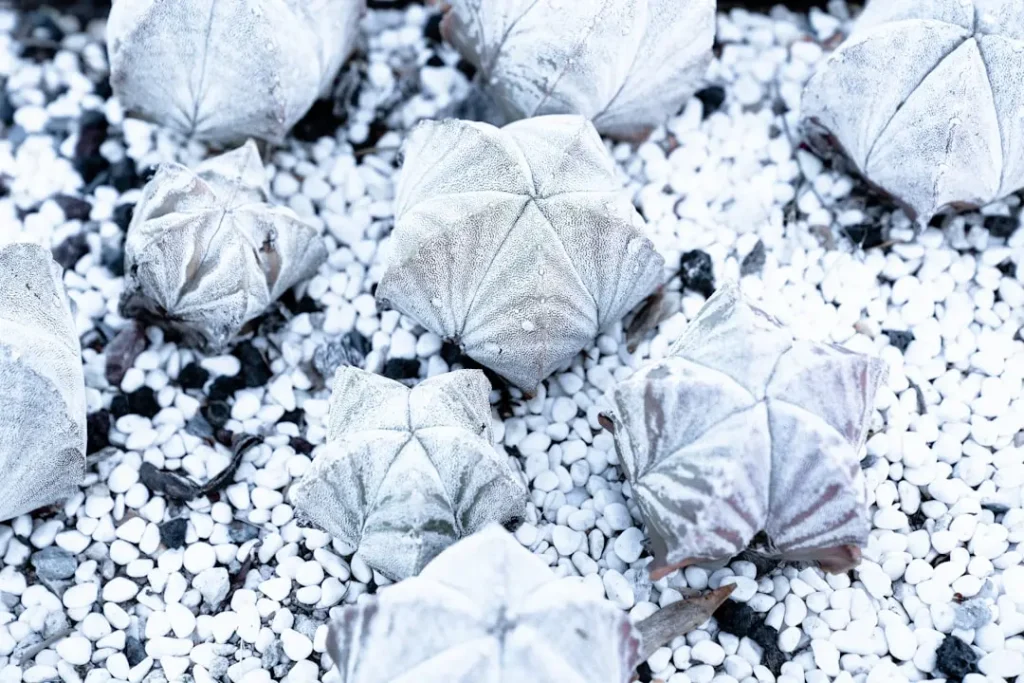
Picture this: a geologist in the Namib Desert in 1811 reaches down to pick up what he thinks is a small, oddly smooth pebble — and it moves. That was William John Burchell’s first encounter with Lithops, and his astonishment is entirely understandable. These plants have spent millions of years perfecting the art of looking like rocks. The name ‘Lithops’ comes from the ancient Greek words ‘lithos’ (stone) and ‘ops’ (face) — quite literally, a stone face. There are over 145 known species and varieties, all native to the arid regions of southern Africa, particularly Namibia, Botswana, and South Africa. Each plant consists of just two fused, succulent leaves with a split down the middle, sitting almost flush with the ground. The leaf tips mimic surrounding pebbles so precisely — in colour, texture, and even translucent ‘windows’ that let light filter into the plant — that even trained eyes can miss them. For more tips, check out our detailed article on how to grow succulents indoors.
Understanding what lithops actually are is the first step in nailing lithops care. They’re not cacti, though they share a love of drought. They’re not typical succulents either. They belong to the family Aizoaceae (the ice plant family), alongside plants like Mesembryanthemum. Their entire biology is built around a short, intense wet season followed by many months of total drought. That rhythm defines everything about how we grow and care for them. According to Kew Gardens, Lithops are one of the most specialised forms of plant mimicry known to science, with distinct ecotypes evolved to match the exact colour and texture of the rock substrate in each locale.
Why Are They Called Living Stones?
The nickname ‘living stones’ captures their most remarkable trait: camouflage so effective it protects them from grazing animals in environments where almost nothing else grows. In their native habitat, lithops experience less than 200mm (8 inches) of rainfall per year — sometimes far less. The plant compensates by absorbing morning mist and dew through its leaf-tip ‘windows,’ which contain specialised translucent cells. This adaptation allows photosynthesis to occur inside the leaf body, safely away from the scorching surface. It’s one of the most elegant survival strategies in the plant kingdom — and it’s exactly why overwatering kills them so quickly. Their tissues simply aren’t designed to hold that much moisture at once. Many gardeners who grow this plant also love to read about Broken Heart Plant Care Guide.
Are Lithops Rare or Easy to Find?
Globally, lithops have become widely available through specialist succulent nurseries, online seed suppliers, and garden centres in the US, UK, Europe, Australia, and increasingly in Asia. In South Africa and Namibia, wild lithops are legally protected under CITES (Convention on International Trade in Endangered Species), so all commercially available plants come from cultivated stock. For growers in tropical countries like India, Singapore, or the Philippines, lithops can be grown successfully with climate-specific adjustments — particularly around humidity management — which we’ll cover in detail further on. The good news is that properly grown lithops are not expensive and are increasingly popular as houseplants worldwide. Many gardeners who grow this plant also love to read about Kalanchoe Plant Indoor Outdoor.
Lithops Plant Characteristics at a Glance
Before diving into the care details, it helps to understand the plant you’re working with. The characteristics table below gives you a quick-reference overview of everything relevant to lithops care — from growth rate to toxicity to preferred soil pH. Refer back to this whenever you need a fast answer. For more tips, check out our detailed article on how to grow succulents indoors.
Lithops Names Around the World
Lithops go by many names across different cultures and languages. While ‘living stones’ is the most widely recognised common name in English-speaking countries, local names often reflect the plant’s unusual appearance or habitat. The names table below covers 21 languages and regions to help gardeners everywhere identify and discuss this unique plant.
The Benefits of Growing Lithops
Lithops won’t fill your kitchen with fresh herbs or scent your hallway with flowers — but they offer a different kind of value that’s hard to match. Here’s what makes them worth growing. First and most practically, they’re extraordinarily low-maintenance once you understand their cycle. A healthy lithops plant can go weeks — even months — without water during its dry rest phase. That makes them ideal for busy professionals, frequent travellers, and anyone who has killed every other plant they’ve owned.
Beyond convenience, lithops are genuine conversation starters. In my experience, no other plant prompts as many ‘wait, is that real?’ reactions from visitors. Their sculptural, alien appearance makes them a popular choice in modern minimalist interiors, terrarium arrangements, and zen-style container gardens. Interior designers in cities like Tokyo, New York, and Melbourne have embraced them as living art objects — and for good reason. Furthermore, because they stay small (most species top out at 3–5 cm or 1–2 inches tall), they’re perfect for apartments, offices, and windowsill collections where space is limited.
From a horticultural perspective, growing lithops also deepens your understanding of plant biology. Learning to read their cycle — knowing when to water, when to hold back, and why — builds skills that transfer directly to growing other succulents and drought-tolerant plants. Many gardeners find that mastering lithops care transforms how they approach all their plants.
Do Lithops Have Medicinal Uses?
Lithops don’t have a documented history in Ayurveda, Traditional Chinese Medicine, or Western herbalism — largely because they’re native to a region with a different ethnobotanical tradition. However, some communities in southern Africa have traditionally used related Aizoaceae family members medicinally. The San people of the Kalahari are documented to have chewed certain Lithops species during long hunts to suppress thirst and hunger, according to ethnobotanical records compiled by the USDA Plants Database. This should not be taken as dietary advice — there’s no clinical evidence for safety or efficacy, and many succulent family members contain compounds that can cause digestive upset. Grow lithops for their beauty, not their medicine cabinet value.
How to Grow Lithops: Step-by-Step Setup
Getting your lithops setup right from day one is the single biggest factor in long-term success. Many gardeners receive a lithops plant, pop it into regular potting soil, water it the same way as their other succulents, and then wonder why it collapses within weeks. The problem isn’t the plant — it’s the environment. Here’s how to set things up correctly from the start.
Choose a container with generous drainage holes. Terracotta pots are excellent because their porous walls wick away excess moisture — a significant advantage for a plant that hates wet roots. Ceramic or plastic pots work too, but drainage becomes even more critical. In humid climates like coastal India, Singapore, or Queensland, Australia, terracotta is strongly recommended. The pot doesn’t need to be large. Lithops have surprisingly shallow root systems for their drought tolerance, so a pot 8–10 cm (3–4 inches) deep is usually sufficient for a small cluster.
Position matters enormously. Lithops need a bright, south-facing windowsill in the Northern Hemisphere (north-facing in Australia and New Zealand). A minimum of 4–6 hours of direct sunlight per day is ideal. In temperate climates like the UK or Canada, a south-facing window that gets full afternoon sun is often the only viable indoor spot during winter. Meanwhile, in hot climates like the Middle East or inland Australia, some afternoon shade in summer prevents scorching — but more on that in the sunlight section.
Choosing the Right Container
Terracotta is the gold standard for lithops containers. Its breathable walls help the growing medium dry out quickly between waterings — a critical factor in lithops care. However, wide, shallow dishes called ‘succulent bowls’ are also popular, especially for growing multiple lithops together as a display. If you go this route, make sure drainage holes are generous. Avoid glass terrariums without airflow — lithops rot quickly in closed, humid environments. A gravel or coarse sand top-dressing not only looks attractive but also prevents moisture from sitting against the leaf base after watering.
Indoor vs. Outdoor Growing
Lithops can thrive both indoors and outdoors, depending on your climate. In temperate zones like the UK (USDA zones 9–11, RHS H2), they’re typically grown as houseplants year-round, brought outside in summer. In Mediterranean climates (California, southern France, South Africa), they grow beautifully outdoors in rockeries or raised beds. In tropical climates, indoor growing with good air circulation and controlled watering is usually more reliable. Outdoors, ensure they’re sheltered from prolonged rain — one of the most common causes of rot in cultivated lithops globally.
Soil and Fertilizer for Lithops
Here’s where most gardeners — even experienced ones — make a costly mistake. Standard potting mix is almost always too rich and too water-retentive for lithops. These plants evolved in near-pure mineral substrate: crushed quartz, coarse sand, and gravel. Organic matter in their native soil is virtually zero. So when you plant lithops in peat-based potting compost, you’re setting them up for a slow death by root rot.
The ideal lithops growing medium is 80–90% inorganic grit and 10–20% organic matter at most. A reliable mix used by collectors worldwide combines coarse horticultural grit or perlite (50%), coarse sand (30%), and a tiny amount of loam or cactus compost (20%). You can buy pre-mixed ‘cactus and succulent compost’ from brands like Westland (UK), Miracle-Gro (US), or Lechuza (Germany) — but always add extra grit at a 1:1 ratio to make it leaner. The RHS recommends a grit-to-compost ratio of at least 1:1 for most succulent family plants, and for lithops, leaning even grittier (2:1 or 3:1 grit-to-compost) produces better results in my experience.
Soil pH should sit between 6.0 and 7.0 — slightly acidic to neutral. Avoid lime-enriched soils or mixes with high phosphorus, which can trigger excessive growth that the plant’s tissues can’t support.
Should You Fertilize Lithops?
Fertilizing lithops is genuinely optional — and less is always more. In their natural habitat, these plants grow in almost nutrient-free substrate, so they’ve adapted to thrive on very little. If you want to fertilize, use a highly diluted, low-nitrogen cactus fertilizer (like a 2-7-7 NPK ratio) once per year during the active growing phase in autumn (September–November in the Northern Hemisphere). Never fertilize during dormancy or the dry rest period. High-nitrogen fertilizers cause soft, vulnerable growth that collapses easily. Many experienced growers simply don’t fertilize at all — and their plants do beautifully.
Watering Lithops: The Most Critical Skill
If there is one single skill that separates successful lithops care from failure, it’s watering. Get this right, and everything else falls into place. Get it wrong, and even a perfectly healthy plant will collapse within weeks. The core principle: lithops have a very specific annual cycle, and watering must follow that cycle — not your own schedule or intuition.
The lifecycle looks like this. In summer (roughly June–August in the Northern Hemisphere), lithops go into full dormancy. During this period, they need virtually no water. The old leaf pair is slowly being absorbed by the new pair developing beneath. Watering during this phase interrupts that process and causes the old leaves to swell, split prematurely, and rot. This is the period when most beginners kill their plants — they see the plant looking ‘dry’ and water it.
In early autumn (September–October, Northern Hemisphere), the plant wakes up. The new leaf pair has fully formed, and this is when you start watering again — lightly, every 2–3 weeks. Flowering typically occurs between September and November. After flowering, keep watering lightly through winter until around February or March, then stop entirely as the plant enters its spring absorption phase. Resume light watering again in late spring only if the old leaf pair has fully shrivelled and been absorbed.
When you do water, water deeply — let the entire substrate get wet, then let it dry completely before watering again. Never water little and often. That’s one of the most common mistakes with succulents generally, and it’s particularly damaging for lithops.
The Seasonal Watering Calendar
Here’s a simple watering guide by season for Northern Hemisphere growers (reverse for Southern Hemisphere growers in Australia, South Africa, New Zealand, and South America):
• January–February: Light watering every 3–4 weeks if old leaves are still absorbing • March–May: Stop watering entirely — spring dry rest • June–August: No water — summer dormancy • September–October: Resume watering every 2–3 weeks — active growth and flowering season • November–December: Light watering every 3–4 weeks
Growers in tropical climates (India, Southeast Asia, equatorial Africa) should note that the seasonal cues are less clearly defined by temperature. Instead, match your watering calendar to the plant’s visual cues: water only when the new leaf pair is fully visible and the old pair has begun shrivelling.
How to Tell If You've Overwatered
Overwatered lithops turn translucent, then mushy, then collapse — often from the base upward. If you catch it early, remove the plant from its pot, let the roots air-dry for 24–48 hours, repot in fresh dry grit mix, and hold off watering for at least three weeks. Unfortunately, heavily rotted lithops rarely recover. Prevention is everything here. Under-watering, on the other hand, causes slight wrinkling of the leaf surface — which is easily reversed with a single watering. Always err on the side of too dry rather than too wet.
Sunlight Requirements for Healthy Lithops
Lithops are sun-worshippers. Full stop. In their natural habitat, they bake under near-equatorial sun for 10–12 hours a day with zero shade. That doesn’t mean you should replicate those exact conditions blindly — especially during extreme summer heat — but it does mean that low light is their enemy.
Indoors, place lithops on the brightest windowsill you have. South-facing in the Northern Hemisphere, north-facing in Australia and New Zealand. Aim for at least 4–6 hours of direct sunlight daily. In regions with weak winter sun — like the UK, Canada, or northern Europe — lithops often don’t get enough light indoors between October and March. Many growers in these regions supplement with a full-spectrum grow light (5000–6500K colour temperature) placed 15–20 cm (6–8 inches) above the plants for 10–12 hours per day during the darkest months. This makes a dramatic difference.
In very hot climates — the Middle East, inland Australia, or the Indian subcontinent in peak summer — intense afternoon sun through glass can scorch lithops leaves, creating white or tan bleached patches. In these situations, a light shade cloth or moving the plant a metre back from the window in the hottest afternoon hours is wise. However, don’t overcompensate — lithops that are chronically under-lit become etiolated, growing long and pale in a desperate stretch toward the light. Etiolated plants are structurally weak and rarely look good again.
Signs of Too Much or Too Little Light
Too much direct light (especially through glass in hot climates): bleached, white, or tan patches on leaf surfaces; sometimes a reddish tinge as a stress response. This is cosmetic rather than fatal if caught early — move the plant to slightly filtered light.
Too little light: lithops grow unnaturally tall and thin (etiolation), become pale green instead of their natural grey, brown, or maroon tones, and lose the distinctive patterning on their leaf surfaces. Etiolated plants are also more vulnerable to rot. The fix is to gradually increase light exposure — never move from deep shade to full sun in one step, or you risk sunburn.
Common Lithops Problems and How to Fix Them
Even with the best lithops care routine, problems can arise. The good news is that most issues come down to just a handful of root causes — and once you understand what’s happening, the fixes are straightforward.
Root rot is the most common cause of lithops death, and it’s almost always caused by overwatering or poorly draining soil. The first sign is a soft, mushy appearance at the base of the leaf pair. If you catch it early, repot immediately into dry grit mix and withhold water for a month. However, prevention is far more effective than treatment.
Premature splitting occurs when a lithops is watered during its dry rest or dormancy phases. The old leaf pair swells and splits before the new pair is ready to emerge. This opens the plant to infection and disrupts the energy transfer from old to new growth. If it happens, simply withhold water and allow the old leaves to dry and collapse naturally.
Mealybugs are the most likely pest you’ll encounter. These tiny white, cottony insects cluster at the base of the leaf split and feed on plant sap. Treat with a cotton swab dipped in 70% isopropyl alcohol, applied directly to the insects. A diluted neem oil spray (2ml per litre of water) used monthly as a preventive measure is also effective. Fungus gnats can be a problem in overly damp growing media — the fix is simply to let the soil dry more thoroughly between waterings.
Why Is My Lithops Wrinkling?
Slight wrinkling of the leaf surface is normal and usually indicates mild dehydration — which can be a healthy sign during the dry rest phase. If wrinkling occurs during the active growing period (autumn–winter), a single deep watering will plump the leaves back up within a day or two. However, if the wrinkling is accompanied by a soft or mushy texture rather than a firm one, that’s a sign of root damage — usually from rot — rather than thirst. In that case, withhold water and inspect the roots. If they’re brown and mushy, repot in fresh, dry mix.
Why Isn't My Lithops Flowering?
Lithops typically begin flowering at 3–5 years of age, so young plants won’t bloom regardless of care. If your mature plant still isn’t flowering, the most likely culprits are insufficient light, watering at the wrong time of year, or incorrect seasonal cues from being grown indoors year-round. Ensuring at least 6 hours of direct sun in autumn and following the watering calendar above will usually trigger flowering in healthy, mature plants. Daisy-like flowers — yellow, white, or occasionally orange — emerge from the central split between September and November in the Northern Hemisphere.
Propagating Lithops: Seeds and Division
Propagating lithops is one of the most rewarding parts of the hobby — and also one of the most patience-testing. These plants grow slowly. Very slowly. But the process itself isn’t complicated, and starting from seed gives you an extraordinary diversity of patterns and colours to work with.
The most common propagation method for home growers is seed. Lithops seed is tiny — almost dust-like — and is available from specialist succulent seed suppliers worldwide, including Mesa Garden (US), Köhres (Germany), and various eBay and Etsy sellers globally. Sow seeds in a shallow tray of near-pure mineral grit, just barely covering them with a sprinkle of fine sand. Mist lightly to moisten the surface, then cover with a clear plastic lid or cling film to maintain humidity. Keep at 20–25°C (68–77°F) in bright but indirect light. Germination usually occurs within 7–21 days.
For the first six months, water seedlings very lightly — just enough to prevent complete desiccation. Seedlings are far more vulnerable than adults to both drying out and rotting. After 6 months, gradually transition to the adult watering calendar. Expect your seedlings to reach adult size in 3–5 years — so if you’re gifting lithops to a friend, mention this. They’ll need patience.
Division is only possible when a lithops plant has produced multiple heads, which happens gradually as the plant matures. Each division must have its own intact root system. Allow the cut surface to callous for 24 hours before repotting in dry grit mix, and withhold water for 2–3 weeks.
Growing Lithops from Seed: Step-by-Step
1. Fill a shallow, well-draining tray with a near-pure grit mix (80% coarse horticultural sand, 20% fine perlite). 2. Surface-sow seeds — do not bury them deeply. Cover with a very thin layer of fine sand. 3. Mist the surface with a spray bottle until evenly damp. 4. Cover the tray with a clear plastic lid and place in bright, indirect light at 20–25°C (68–77°F). 5. Check daily — mist lightly if the surface feels completely dry. Never let it become waterlogged. 6. Once germination occurs (usually 7–21 days), remove the cover gradually over one week to acclimate seedlings to open air. 7. After 6 months, transition to the adult watering schedule very gradually.
Seasonal Lithops Care Through the Year
One of the trickiest things about lithops care is that most general plant advice doesn’t apply. Seasonality matters intensely, and it matters differently depending on where you live. Let’s walk through a full year of care, with notes for different climate zones.
For growers in the Northern Hemisphere (Europe, North America, most of Asia): the main active growing and flowering season runs from September through November. This is when you water, when flowers appear, and when the new leaf pair is actively developing inside the old one. From December through February, light watering continues but slows. March through May is the critical spring dry rest — water very sparingly or not at all as the old leaf pair is absorbed. June through August is full summer dormancy: no water, bright light, warm temperatures.
For Southern Hemisphere growers (Australia, South Africa, New Zealand, southern South America): simply reverse the calendar. Active growing season is March–May, spring dry rest is September–November, and summer dormancy falls in December–February.
For tropical growers (India, Southeast Asia, equatorial Africa, Central America): seasonal temperature variation is minimal, so the plant’s cycle is best tracked visually. Watch the leaf pair itself — the moment you see a new pair beginning to push through the split, enter dry rest mode regardless of the calendar month. Water again only when the old pair has fully shrivelled. In high-humidity climates, excellent air circulation (a small fan near the plants) is essential to prevent fungal issues during any moist period.
For an excellent overview of general indoor plant care guide principles that complement lithops care, including soil, light, and container choices across multiple plant families, our comprehensive guide covers everything you need.
June Lithops Care: What to Do Right Now
June is full summer dormancy for Northern Hemisphere growers — and this is the month that trips up more lithops owners than any other. Your plant may look slightly shrivelled or dull. You’ll feel the urge to water. Resist it entirely. The old leaf pair is currently transferring all its stored energy and water into the new pair forming below. Any water you add disrupts this process. Place the plant in the brightest spot you have, ensure temperatures don’t drop below 10°C (50°F) at night, and simply leave it alone. Southern Hemisphere growers, meanwhile, are heading into their active autumn growing season — time to start light watering and watch for flower buds.
Winter Lithops Care in Cold Climates
Lithops tolerate surprisingly cold temperatures when dry — as low as 5°C (41°F) briefly — but any combination of cold and wet is fatal. In cold climates like Canada, northern Europe, or highland regions of Central Asia, the main winter concern is keeping plants dry while maintaining adequate light. A heated indoor windowsill with supplemental grow lighting is the standard solution. Avoid placing plants near cold draughts from windows, which can cause sudden chilling damage. USDA hardiness zone 10–11 is the outdoor growing range for lithops; in cooler zones, treat them as permanent indoor plants.
Frequently Asked Questions
How often should I water lithops?
During the active growing season (autumn and early winter), water lithops every 2–3 weeks — deeply, then let the substrate dry completely before watering again. During summer dormancy (June–August in the Northern Hemisphere), stop watering entirely. During the spring dry rest phase (March–May), also withhold water. In total, lithops may only need 8–12 proper waterings per year. This minimal schedule is essential for successful lithops care and the single most important factor in keeping the plants alive.
Can I grow lithops indoors in a cold climate?
Yes, absolutely. Lithops are grown successfully as houseplants in cold-climate countries including Canada, the UK, Germany, and Scandinavia. The key is providing enough light — at least 4–6 hours of direct sunlight daily. In climates where winter daylight is weak or short, supplement with a full-spectrum grow light (5000–6500K) placed 15–20 cm above the plants for 10–12 hours daily. Keep them on a south-facing windowsill and ensure temperatures stay above 5°C (41°F). As long as they have light and proper lithops care, cold climates pose no serious obstacle to growing these plants.
Are lithops safe for pets and children?
Lithops are generally considered low-toxicity plants, but they're not entirely without risk. The ASPCA lists Lithops as potentially mildly toxic to cats and dogs — ingestion may cause mild gastrointestinal upset such as vomiting or diarrhoea. They're not considered severely toxic, but as a precaution, keep them out of reach of pets and small children. There are no documented serious cases of lithops poisoning in humans or animals, but the plant's unusual appearance may attract curious pets to investigate or chew on them.
Why is my lithops splitting outside of its normal cycle?
Premature or abnormal splitting almost always results from watering during the dry rest or dormancy phases. When a lithops receives water while the old leaf pair is in the process of being absorbed by the new pair, the old leaves swell with excess moisture and split prematurely. This disrupts the energy transfer process and can leave the plant vulnerable to infection. The fix is to stop watering immediately and allow the old leaves to dry and collapse naturally on their own. Adjust your lithops care watering calendar going forward to strictly follow the seasonal cycle.
How do I grow lithops in containers for a balcony or patio?
Lithops thrive in containers on balconies and patios in Mediterranean, temperate, and arid climates. Use a terracotta pot with multiple drainage holes and a very gritty substrate (80% coarse grit and perlite, 20% cactus compost). Position in full sun — south-facing in the Northern Hemisphere. The critical rule for outdoor container lithops is rain protection: cover them or bring them indoors during prolonged wet weather, as rainwater accumulation in the pot causes root rot rapidly. In climates with hot, dry summers (California, southern Europe, parts of Australia), outdoor balcony growing during summer dormancy is actually ideal — replicating their native conditions closely.
How long do lithops live?
Lithops are remarkably long-lived when grown correctly. In cultivation, well-cared-for plants regularly survive 40–50 years, slowly dividing and forming clusters of multiple heads over time. In their native habitat, individual plants are estimated to live even longer — some quartz field specimens are thought to be over a century old, though accurate dating is nearly impossible. The main reason cultivated lithops die young is almost always poor care — particularly overwatering — rather than natural lifespan. With proper lithops care, the plant you buy today could genuinely outlast your other houseplants by decades.
When do lithops flower, and how do I encourage blooming?
Lithops typically flower between September and November (Northern Hemisphere) — in late afternoon to early evening. Plants usually need to be at least 3–5 years old before they flower for the first time. To encourage blooming, ensure the plant receives at least 6 hours of direct sunlight in the lead-up to autumn, follow the correct dry-season watering calendar strictly, and avoid fertilizing with high-nitrogen products. The daisy-like flowers are stunning and often fragrant — yellow is most common, though white and orange varieties exist. Consistent annual lithops care is the most reliable path to regular flowering.
What is the difference between lithops species?
There are over 145 recognised Lithops species and varieties, differing primarily in the colour, pattern, and texture of their leaf surfaces — which evolved to match specific rock types in their native regions. Lithops lesliei has warm brown tones; L. karasmontana shows grey and rust patterns; L. fulviceps features olive-green with dark markings. Functionally, care requirements are nearly identical across all species. The main variable is their level of cold and heat tolerance, with some high-altitude species slightly more cold-tolerant. For beginners, L. lesliei and L. fulviceps are widely recommended as the most forgiving species to start with.
Final Thoughts
Lithops care rewards the patient gardener like almost no other plant can. Once you understand their rhythm — the summer silence, the autumn awakening, the slow drama of a new pair pushing through the old — you’ll find yourself watching them with genuine fascination rather than worry. The rules are simple: gritty soil, full sun, and a seasonal watering calendar that respects their natural cycle. Break those rules and the plant suffers. Follow them and you’ll have one of the most extraordinary, longest-lived plants in your collection. Whether you’re growing living stones on a windowsill in Edinburgh, a balcony in Singapore, or a sunny porch in Arizona, the fundamentals of lithops care are the same across every climate — just adjusted for local light and seasonal timing. Start with one plant, learn to read its signals, and before long you’ll be hunting down rare species and building a collection that sparks conversation for years to come.

